


PRODUCT DETAILS
Spoon Sports Progressive Lowering Springs - Civic, Integra, S2000, Fit, CR-Z & Prelude
Most lowering springs make you choose. Go cheap and linear and you get the drop along with a car that crashes over everything and still rolls in corners. Spoon took a different approach: a progressive barrel spring that stays mild at the top of its travel and climbs in rate as the car rolls and compresses. You get roll control when you're cornering and a ride you can live with the rest of the time, with a modest 20 to 30mm drop depending on chassis.
Why Progressive Beats Linear
Here's the difference, and it's the whole reason these cost what they do.
A linear spring has one rate. Whatever it is at the first millimeter of compression is what it is at the last. So a spring stiff enough to control body roll in a corner is also stiff enough to punish you over every expansion joint, because it can't tell the difference between the two.
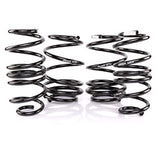
Spoon builds these with irregular pitch and a barrel section, which means the rate changes as the spring compresses. Small inputs, road texture, expansion joints, the stuff you hit constantly, only work the soft part of the spring. Load the car up in a corner or hit a real compression and the rate climbs to resist it. One spring doing two jobs.
That's why these ride better than a linear spring at the same drop while controlling roll better than a soft one. It's not magic, it's just a smarter shape.
Be Honest About The Ride
We'll be straight with you rather than overselling it. These are still stiffer than stock. Progressive rate means the ride is far better than a cheap linear drop spring, not that it's unchanged from factory.
The exception worth mentioning is the FL5. Spoon actually tuned those to take some of the harshness out of the factory Type R setup, so on that car the ride can genuinely improve. On most applications, expect a firmer but well-controlled car rather than a stock one.
Your Dampers Need To Be Healthy
Most important thing on this page. These are designed to work with stock dampers, or Spoon's own fixed dampers, and that's a real requirement rather than a suggestion.
If your shocks are tired, and on anything more than a few years old there's a good chance they are, the car will float over undulations and bottom out on compressions. That's not the springs failing, it's the dampers failing to control them, and lowering the car makes it more obvious rather than less.
So look at your dampers honestly before you order. If they've got real miles on them, budget for those too. Fresh springs on dead shocks is a worse-driving car than what you started with, and plenty of people learn that the expensive way.
Pick Your Chassis
Each application gets its own spring with rates tuned for that car. Find yours:
| Application | Drop (approx.) | Spring Rate (F / R) |
|---|---|---|
| Civic EK4 / EK9 | 20mm | 6.5 / 5.5 kg/mm |
| Integra Type R DC2 / DB8 | 30mm | 6.5 / 5.5 kg/mm |
| Civic Type R FD2 | 25mm | Not published |
| Civic FK7 Hatchback | 30mm | 2.7 / 3.2 kgf/mm |
| Civic Type R FK8 | 20mm | 5.0 / 4.9 kgf/mm |
| Civic FL1 | 25mm | 3.4 / 3.4 kgf/mm |
| Civic Si FE1 / Integra DE4 | 20mm F / 25mm R | 3.4 / 4.5 kgf/mm |
| Civic Type R FL5 | 20mm | 5.5 / 5.0 kgf/mm |
| S2000 AP1 / AP2 | 25mm | 4.7 / 6.9 kg/mm |
| Fit GE8 | 25mm | 2.3 / 2.4 kg/mm |
| Fit GK5 | 25mm | 2.5 / 2.4 kgf/mm |
| CR-Z ZF1 | 25mm | 2.3 / 2.4 kg/mm |
| Prelude BF1 | 20mm | 4.5 / 5.1 kg |
Four springs per set. Note how much the rates vary, an EK Civic gets 6.5 kg/mm up front while a Fit gets 2.3. These aren't one spring with different part numbers, they're tuned per chassis.
Because each application is its own spring, the set you receive may look slightly different from the photos on this page. Spring height, coil count, and barrel shape vary between chassis. What you'll get is the set matching the application you select.
Get Your Chassis Code Right
Worth reading carefully, because the modern Civic lineup has four distinct chassis and they take four different springs.
The FK7 hatchback, FK8 Type R, FL1, and FL5 Type R are all separate applications. Don't assume a "Civic" spring covers your car. In particular, the FL1 is not a Type R, and the FL5 spring won't work on it.
Same on the Integra side. The DCR spring is for the DC2 and DB8 Type R in 96 and 98 spec specifically, not the full 1994-2001 Integra range. And the modern DE4 Integra shares its spring with the FE1 Civic Si.
Plan The Install
A few practical things. This is a spring compressor job, so if you don't have the tools or the experience, it's a reasonable one to hand to a shop, since compressed springs are genuinely dangerous when handled badly.
You'll need an alignment afterward. Lowering a car changes camber and toe, and skipping the alignment means eating tires and driving a car that doesn't track straight. Budget for it as part of the job rather than an afterthought.
Also worth checking while you're there: your inner fender clearance with the wheel and tire setup you're running, and your load-leveling headlights if your car has them, since ride height changes affect their aim.
Fitment
- 1996-2001 Acura Integra Type R (DC2 / DB8, 96 and 98 spec)
- 2023-2026 Acura Integra (DE4)
- 2011-2016 Honda CR-Z (ZF1)
1996-2001 Acura Integra Type R (DC2 / DB8, 96 and 98 spec)
2023-2026 Acura Integra (DE4)
1996-2000 Honda Civic (EK4 / EK9)
2007-2011 Honda Civic Type R (FD2)
2016-2021 Honda Civic Hatchback (FK7, MT and CVT)
2017-2021 Honda Civic Type R (FK8)
2022-2026 Honda Civic Si (FE1)
2022-2026 Honda Civic (FL1, non-Type R)
2023-2026 Honda Civic Type R (FL5)
2011-2016 Honda CR-Z (ZF1)
2009-2013 Honda Fit (GE8)
2015-2020 Honda Fit (GK5)
2026+ Honda Prelude (BF1)
2000-2009 Honda S2000 (AP1 / AP2)