



Description
Stop Fighting Your Coolant Plumbing
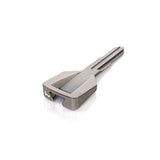
If you've ever done a K-swap or bolted on an aftermarket radiator and then stared at your thermostat neck pointing the wrong direction, you already know why we built this. The factory housing goes where Honda decided, and that's the end of the conversation. Ours doesn't work that way. The main outlet uses a -16 ORB thread and the neck rotates a full 360 degrees, so you aim it wherever your build actually needs it and tighten it down. No creative hose routing. No compromises on radiator placement.
It's machined from billet aluminum and finished in a three-stage Dust Black anodize. This is a part that lives in a hot, pressurized system, so we didn't cut corners on the material or the finish.
The Swivel Is What Makes This Work
That -16 ORB thread is the key. Spin the neck to any angle, lock it in, and run what you want off it. You can connect an OEM-style radiator hose directly, or if your build is plumbed with AN lines, the -16AN radiator fitting accepts that too (the AN fitting is sold separately). On a K-swap especially, where the engine and chassis were never designed to share space, being able to point the outlet exactly where you need it is the difference between clean plumbing and a hose routed like a pretzel.
Standard or HYPERCOOL Low Temp?
We include the standard OEM-spec K-series thermostat with every housing. It begins to open at 172.4°F (78°C), which is factory spec. If your car is a daily driver or mildly modified, this is the right call. It warms up correctly, it behaves predictably, and there's nothing wrong with it.
The HYPERCOOL low-temp thermostat is an optional upgrade. It fully opens at 154.4°F (68°C), which is roughly 18°F sooner than the standard unit. That means coolant starts circulating earlier and your cooling system gets a head start before things build up under load. On a boosted or hard-driven car where you're managing heat, that margin is genuinely useful.
One thing worth being straight about: opening sooner doesn't fix an undersized radiator or solve an actual overheating problem. It buys you headroom, not cooling capacity. And on a cold-weather daily, your engine will take a little longer to reach operating temp. If you're chasing heat on a built car, the HYPERCOOL makes sense. If not, run the standard.
The Sensor Port You've Been Looking For
There's a threaded M18x1.5 port on top of the housing. If you're running a standalone ECU, an aftermarket coolant temp gauge, or any auxiliary sensor, this gives you a clean, proper location for it instead of a tee fitting spliced into a hose. If you don't need it, it plugs off and stays out of the way.
Fitment
This housing fits K20A/Z thermostat bases and K24(A) series thermostat bases. It also works on K-swaps built around these engines, since it mounts to the thermostat base rather than the chassis. Note on Civic fitment: this part fits K-engine Civic variants only, which means 2002-2005 Civic (all) and 2006-2015 Civic Si. It does not fit every Civic trim sold in those years.
| Make | Model | Years |
|---|---|---|
| Acura | RSX | 2002-2006 |
| Acura | TSX | 2004-2014 |
| Honda | Accord | 2003-2007 |
| Honda | Civic (K-engine variants) | 2002-2015 |
| Honda | CR-V | 2002-2006 |
Who This Is For
If you're doing a K-swap and need routing flexibility, this is the obvious move. If you're replacing a tired factory housing and would rather put something better on than another plastic unit, same answer. Swap builders get the freedom to aim the outlet where they actually need it. Boosted or track-driven cars get the low-temp thermostat option. Everyone gets a housing that seals properly with an included OEM-style O-ring and doesn't make you think about it again.
Pick your thermostat, point the neck where your build needs it, done.
FITMENT
| 2007-2010 Acura CSX Type S |
| 2002-2006 Acura RSX |
| 2004-2008 Acura TSX |
| 2003-2007 Honda Accord |
| 2002-2015 Honda Civic Si |
| 2002-2006 Honda CR-V |
| 2003-2011 Honda Element |
INSTALL GUIDE
TECHNICAL DATA
Standard Temp - Fully open at 78*C / 172.4*F
HYPERCOOL Low Temp - Fully open @ 68*C / 154.4*F