

PRODUCT DETAILS
Mishimoto Aluminum Radiator - 1994-1997 Honda Accord / 1997-1999 Acura CL / 1997-2001 Prelude (Manual Transmission)
Your Accord, CL, or Prelude's got a radiator that's been in there since the Clinton administration. The plastic end tanks are cracked or they're about to crack. The core's half-clogged with rust and scale. You're watching the temp gauge creep up when you're sitting in traffic and you know where this is going. It's going to blow. Probably on the highway. Probably when it's 95°F outside. Mishimoto's all-aluminum radiator gets rid of every weak point in the stock setup. TIG-welded aluminum end tanks instead of brittle plastic. Two-row brazed aluminum core that's 1.97 inches thick instead of the thin single-row stock core. No plastic to crack. No crimped seams to leak. No clogged tubes choking your coolant flow. You're bolting this in and you're not thinking about your radiator again for the next 200,000 miles. Mishimoto backs it with a lifetime warranty. If it leaks, they replace it. That's how sure they are it's not going to fail like your stock plastic-tank radiator that's already living on borrowed time.
Here's What Kills Every Stock Accord/CL/Prelude Radiator
Every single one of these cars left the factory with the same radiator design. Aluminum core. Plastic end tanks. Crimped seams where the plastic meets the aluminum. That design's fine when it's new. Twenty-five years later? It's garbage. The plastic gets heat-cycled thousands of times. It gets brittle. The tanks crack around the inlet neck or the outlet neck or right along the crimped seam. We've had customers drive in with coolant dripping out of hairline cracks they didn't even know were there. The crack's small enough that it's not pouring out but it's weeping coolant constantly and the level's dropping. One day the crack opens up all the way and now you're on the side of the road with coolant pouring out and the temp gauge pegged. The core's also full of rust, scale, and sediment because nobody's flushed their coolant in 10 years. Half the tubes are clogged. Coolant's trying to flow but it can't get through. Your radiator's working at 50% capacity. Mishimoto's radiator is all aluminum. The end tanks are TIG-welded. There's no plastic. There's no crimped seam. The core's brand new and clean so every tube's flowing. You're getting actual cooling instead of fighting a clogged 30-year-old radiator that's trying its best but can't keep up anymore.
Two-Row Core Means Way More Cooling Capacity
The stock radiator's got a single-row core. Mishimoto's got a two-row core that's 1.97 inches thick. That's almost twice as thick as stock. Two rows means you've got twice the tube surface area for coolant to flow through and twice the fin surface area for air to pass over. More surface area means more heat transfer. The core holds 2.06 gallons of coolant which is more than stock. More coolant volume means more thermal mass. It takes longer for the coolant to heat up and you've got more capacity to absorb heat spikes when you're sitting at a stoplight with the A/C blasting on a 95°F day. Mishimoto uses 100% brazed aluminum construction. That's vacuum brazing where they're heating the core in a vacuum chamber and fusing the joints together without solder. The tubes aren't going to separate. The fins aren't going to come loose. This isn't some cheap eBay radiator where the fins fall off when you sneeze on it. Mishimoto builds radiators for people running turbocharged Preludes making 500 whp at track days. If it can handle that, it can handle your stock H22 or F22 sitting in stop-and-go traffic.
High-Pressure Cap Raises Your Boiling Point
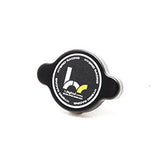
Mishimoto throws in a 1.3 bar high-pressure radiator cap with this radiator. Your stock cap's 1.1 bar. Here's why that matters. Water boils at 212°F at sea level with no pressure. At 16 PSI (1.1 bar) it boils at around 250°F. At 18.85 PSI (1.3 bar) it boils at around 257°F. You're getting an extra 7°F of boiling point headroom before your coolant starts forming vapor pockets and burping out the overflow bottle. That matters when you're running hard or when you're creeping along in traffic on a hot day. The higher pressure also helps coolant flow because the water pump's pushing against less cavitation. Use the Mishimoto cap that comes with the radiator. Don't use your crusty old stock cap. The Mishimoto cap's designed to seal on the Mishimoto filler neck.
Magnetic Drain Plug Catches All the Junk Floating Around
Mishimoto includes a magnetic drain plug on this radiator. The magnet catches all the metallic crap floating in your coolant. Rust particles. Aluminum oxide from corrosion. Metal shavings from your water pump impeller or bearings. All of that junk's circulating through your cooling system and clogging your heater core or scratching your water pump seal. The magnet grabs it and holds it on the drain plug so it's not floating around causing problems. When you drain your coolant, pull the plug and look at the magnetic tip. You'll be surprised how much metal's stuck to it. That's stuff that would've been grinding through your cooling system if the magnet wasn't catching it. Wipe it off and put the plug back in. Next time you drain the coolant, check it again. It's usually way worse than you think it's going to be.
Bolts Right In - No Cutting, No Fabricating
This is a direct OEM replacement. Same bolt holes as the stock radiator. Same hose connections. You're pulling the old radiator out and dropping this one in. That's it. No cutting. No drilling. No custom brackets. The inlet's 1.25 inches and the outlet's 1.5 inches. That's stock hose size. You're using your stock upper and lower hoses. You're using your stock fan. You're using your stock shroud. Everything bolts up exactly like the factory radiator did. If you've done cooling system work before, this takes you two hours. Drain the old coolant, unbolt the old radiator, bolt in the Mishimoto, fill it with fresh coolant, burp the air out, and you're done. If it leaks or fails at any point, Mishimoto replaces it. Lifetime warranty. They're that confident it's not going to crack or corrode like the stock radiator that's already on its way out.
What You Get
- Mishimoto all-aluminum radiator for 1994-1997 Accord / 1997-1999 CL / 1997-2001 Prelude (manual trans only)
- TIG-welded aluminum end tanks (no plastic, no crimped seams)
- Two-row brazed aluminum core (1.97 inches thick, way thicker than stock single-row)
- 2.06 gallon capacity (more coolant volume than stock)
- 1.25 inch inlet, 1.5 inch outlet (stock hose sizes, reuse your hoses)
- 1.3 bar high-pressure radiator cap (raises boiling point to ~257°F, don't use stock cap)
- Magnetic drain plug (M12 x 1.5 thread, catches rust, corrosion particles, metal shavings)
- Direct bolt-in (stock mounting points, stock fan and shroud)
- Mishimoto lifetime warranty (if it leaks or fails, they replace it)
- Made by Mishimoto
Fits These Cars
- 1994-1997 Honda Accord 2.2L (manual transmission only)
- 1997-1999 Acura CL 2.2L/2.3L (manual transmission only)
- 1997-2001 Honda Prelude 2.2L (manual transmission only)
Note: Manual transmission only - automatic cars have transmission cooler in radiator, this radiator doesn't have one so it won't work. Stock radiators have plastic end tanks that crack after 25+ years - Mishimoto's all aluminum with TIG-welded tanks (no plastic to fail). Two-row core 1.97 inches thick with 2.06 gallon capacity (stock is single-row and thinner). Direct bolt-in using stock mounting points and stock hose sizes (1.25 inch inlet, 1.5 inch outlet). Reuse stock upper and lower hoses, stock fan, stock shroud. 1.3 bar high-pressure cap included (raises boiling point from ~250°F to ~257°F, use Mishimoto cap not stock cap). Magnetic drain plug catches metallic debris - pull plug when draining coolant and check magnetic tip (you'll see rust particles, aluminum oxide, metal shavings stuck to magnet). 100% brazed aluminum core (vacuum brazed, no solder, tubes won't separate). Designed for stock and modified engines (handles 500+ whp turbo builds). Mishimoto lifetime warranty. Installation takes 2 hours if you've done cooling system work (drain old coolant, unbolt old radiator, bolt in Mishimoto, refill coolant, burp air). Made by Mishimoto.