

PRODUCT DETAILS
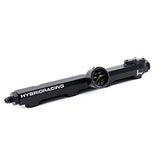
AEM High Capacity Adjustable Fuel Pressure Regulator - 40-130 PSI
Running a big fuel pump and bigger injectors on your turbo K series or boosted B series and your fuel pressure's all over the place? The AEM high capacity adjustable fuel pressure regulator (part number 25-305BK) gives you stable, adjustable fuel pressure from 40 to 130 PSI. I've been running AEM regulators on my turbo Hondas for years because they actually hold pressure under boost without creeping. Your stock fuel pressure regulator's designed for 40-50 PSI and it can't handle high-flow pumps or high boost. When you're running a Walbro 450 or an Aeromotive pump with 1000cc injectors and 25+ PSI of boost, your stock regulator either creeps (pressure goes up when it shouldn't) or it can't flow enough fuel. The AEM regulator's got a huge return orifice that handles high pump flow without pressure creep, and it's got true 1:1 rising rate so your fuel pressure increases 1 PSI for every 1 PSI of boost.
Here's Why Stock Regulators Fail with Big Pumps
Your stock fuel pressure regulator's a simple spring-loaded valve. It's designed to maintain 40-50 PSI base pressure and rise 1:1 with boost. That works fine with a stock fuel pump flowing 200-300 liters per hour. But when you install a high-flow pump like a Walbro 450 (450 lph) or an Aeromotive pump (600+ lph), your stock regulator can't handle the volume. The return orifice (the hole where excess fuel goes back to the tank) is too small. When the pump's dumping 450 lph through a regulator designed for 250 lph, the regulator can't bypass enough fuel fast enough. Pressure creeps up at idle and cruise because the regulator's overwhelmed. You'll see 50 PSI at idle when you want 43 PSI, or pressure spikes to 60+ PSI on decel. That screws up your tune because your fuel trims are chasing a moving target. The AEM regulator's got a way bigger return orifice that handles high pump flow without creeping.
40-130 PSI Adjustment Range
The AEM regulator adjusts from 40 to 130 PSI base pressure. Most people run 43 PSI base pressure (same as stock Honda fuel pressure) or 58 PSI for E85 setups. The adjustment screw on top lets you dial in your exact pressure. Once you set it, there's a set screw that locks the adjustment so it doesn't drift. I've seen cheap regulators where the adjustment drifts after a few heat cycles or vibration loosens it. The AEM regulator stays put once you lock it down. If you're running E85 or race gas and you need higher base pressure for injector flow, you can crank it up to 65-70 PSI. If you're running a returnless fuel system conversion, you can set whatever base pressure you want.
True 1:1 Rising Rate for Boost
The AEM regulator's got a 1:1 rising rate when you connect it to a boost reference. That means for every 1 PSI of boost, your fuel pressure increases 1 PSI. If you're running 43 PSI base pressure and 20 PSI of boost, your fuel pressure at full boost is 63 PSI. That 1:1 rising rate keeps your injector differential pressure constant. Differential pressure is the difference between fuel pressure and manifold pressure. If fuel pressure rises 1:1 with boost, your injectors see the same pressure differential at 20 PSI boost as they do at vacuum. That means your injector flow rate stays consistent and your fuel table doesn't need boost-dependent corrections. Some cheap regulators don't maintain true 1:1, they creep or lag, and your tune gets messy.
Works with E85, Race Gas, and Pump Gas
The AEM regulator's compatible with gasoline, E85, methanol, and race gas. The internal diaphragm and seals are alcohol-resistant. If you're running E85 or methanol, you need higher fuel pressure to get enough injector flow because E85 needs 30% more fuel volume than gasoline. Most people running E85 set their base pressure to 58 PSI instead of 43 PSI. The AEM regulator handles that without any issues. I've run E85 through mine for years with zero diaphragm failures or seal degradation.
9/16"-18 Inlet and Return Fittings
The regulator uses 9/16"-18 ORB (O-ring Boss) fittings on the inlet and return ports (Not included). That's a common AN fitting size. You're running -6 AN or -8 AN fuel lines from your fuel rail to the regulator inlet, and -6 AN return line from the regulator back to your fuel tank. The fittings use O-rings for sealing, not thread sealant or PTFE tape. The regulator also has a 1/8 NPT gauge port where you can install a fuel pressure gauge or a fuel pressure sensor for your ECU. I always run a fuel pressure sensor so I can data log fuel pressure and catch problems before they grenade my engine.
What You Get
- AEM high capacity adjustable fuel pressure regulator
- Part number: 25-305BK
- Adjustment range: 40-130 PSI base pressure
- Large return orifice (handles high-flow pumps without pressure creep)
- True 1:1 rising rate with boost reference
- Inlet port: 9/16"-18 ORB (O-ring Boss)
- Return port: 9/16"-18 ORB (O-ring Boss)
- Gauge port: 1/8 NPT
- Boost reference port: 1/8 NPT
- Adjustment screw with set screw lock
- Compatible with gasoline, E85, methanol, race gas
- Black anodized finish
Works With
- High-flow fuel pumps (Walbro 255/450, Aeromotive, DeatschWerks, etc.)
- Large injectors (800cc, 1000cc, 1200cc+)
- Turbocharged and supercharged engines
- E85, methanol, race gas fuel systems
- Returnless fuel system conversions
- Universal fitment (works on any fuel system with -6 or -8 AN lines)
Note: This regulator requires a return fuel line back to your tank. If you're running a stock returnless fuel system, you'll need to install a return line or convert to a return-style fuel system. You can't use this regulator on a returnless system. The boost reference port connects to your intake manifold with a vacuum line. Make sure you're pulling boost reference from after your throttle body, not before. If you pull reference from your cold side piping before the throttle body, the regulator won't work right. When you're setting base fuel pressure, disconnect the boost reference line and adjust the screw with the engine at idle or with a fuel pressure gauge and pump prime. Don't set base pressure under boost or you'll set it wrong. The set screw locks your adjustment in place. Tighten it after you've dialed in your base pressure or the adjustment will drift from vibration. If you're running E85 and you want higher base pressure for injector flow, set it to 58 PSI. If you're running pump gas, set it to 43 PSI (stock Honda fuel pressure). Data log your fuel pressure if you can. Fuel pressure creep or drop-off under load means something's wrong with your fuel system.