

PRODUCT DETAILS
Genuine Honda Crank Pulley (13810-RRA-A02) - K20A3 & K24A
The crank pulley does more than drive your accessories. It's a harmonic damper, absorbing the torsional vibration the crankshaft produces on every combustion event. When the rubber bonding inside it degrades, it stops damping, and those vibrations go somewhere less forgiving. This is the genuine Honda replacement, 6.125 inches in diameter running a 7-rib belt.
What A Failing Pulley Looks Like
These fail in a specific and recognizable way.
The pulley is built in two pieces, an inner hub and an outer ring, bonded with rubber between them. That rubber absorbs vibration, and over time and heat cycles it degrades.
What you see is the outer ring separating or walking relative to the inner hub. Sometimes there's visible rubber cracking or missing chunks. Sometimes the outer ring has shifted enough that your belt no longer tracks straight, which shows up as belt wear or squealing you can't chase down.
The serious version is the outer ring letting go entirely at speed, which takes your accessory belt with it and can do real damage on the way out.
Why Damping Matters Beyond The Noise
Easy to think of this as just a pulley, so it's worth understanding what it's actually doing.
A crankshaft doesn't rotate smoothly. Every combustion event twists it and it springs back, which sets up torsional vibration along its length. Left unchecked, that vibration is genuinely destructive to the crank, the bearings, and anything driven off the front of the engine.
The damper absorbs it. When it stops working, those vibrations don't go away, they just have nowhere useful to go. That's why a degraded pulley isn't only a belt problem.
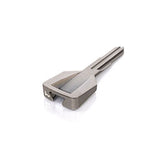
Grab A New Woodruff Key
Worth adding to your order, since it's the small part that makes this job go properly.
The crank pulley key indexes the pulley to the crankshaft. It's inexpensive, it's easy to damage on removal, and a worn or nicked key means a pulley that doesn't seat exactly right. That allows movement, and movement eventually wallows out the keyway in the crankshaft itself.
Given that you're already in there and the key costs almost nothing, there's no sensible reason to reuse the old one.
Use The Genuine Part
The damping characteristics are the specification here, and they're tuned to the engine. A pulley that bolts on and spins isn't necessarily absorbing the frequencies a K-series produces.
Underdrive and lightweight pulleys exist and have their place on a race engine, but they're a different product with different tradeoffs, including reduced damping. If you want a factory-behaving engine, this is the part.
Common In K-Swaps Too
Beyond stock replacement, this is a regular part in swap builds. The K20A3, K24A1, K24A2, K24A4, and K24A8 all use it, which covers a lot of what goes into swapped chassis.
If you're assembling an engine from parts of unknown history, a fresh pulley is cheap insurance on a component that's easy to overlook and expensive to ignore.
Fitment
2002-2005 Honda Civic Si
2002-2006 Acura RSX Base
2002-2006 Honda CR-V
2003-2005 Honda Accord
2003-2006 Honda Element
2004-2008 Acura TSX
Covers K20A3, K24A1, K24A2, K24A4, and K24A8. Part number 13810-RRA-A02. 6.125" diameter, 7-rib belt.
Who Should Grab One
This is for the K-series owner who's found a separating pulley, a belt that won't track straight, or vibration that wasn't there before. It's also worth doing on a high mileage engine you're going through, since the rubber degrades on a calendar as much as on an odometer. Add the woodruff key, torque it properly, and get the front of the engine back to doing its job.
Fits: see the application list above. Part number: 13810-RRA-A02. Engines: K20A3, K24A1, K24A2, K24A4, K24A8. Diameter: 6.125" (15.56 cm). Belt: 7-rib. Type: genuine Honda crank pulley and harmonic damper. Recommended: new crank pulley key, part 90704-PNA-000.